This is a paid advertisement for Aduro Clean Technologies (NASDAQ: ADUR). Full disclaimer below.

Nasdaq: ADUR  /  TSX: ACT  /  FSE: 9D5

Difficult feedstocks. Different chemistry pathways.Moving toward industrial scale.

Aduro Clean Technologies is a chemical technology developer. Hydrochemolytic™ Technology (HCT) is the most advanced pathway: a patent-backed thermo-catalytic technology that uses water in the process and is being developed for waste plastics, heavy bitumen and paraffinic crude. Renewable oils and BTX platform chemicals sit in separate, earlier-stage research pathways.

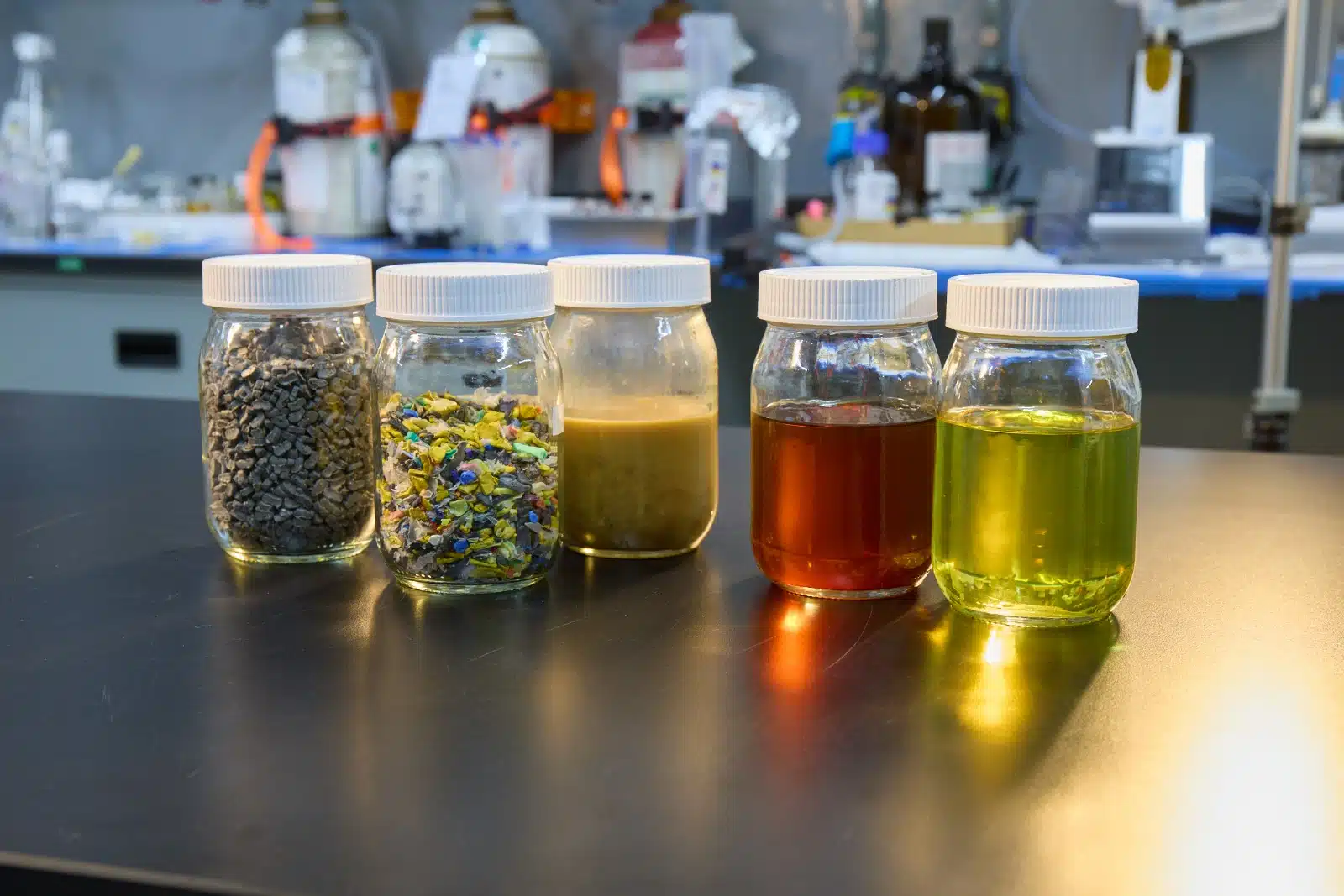
Glass jars showing plastic feedstock and the liquid hydrocarbon products made from it

10 kg/hr

The NGP Pilot Plant in London, Ontario. Operating campaigns began in February 2026.

Operating now

86% liquid

Share of polypropylene feed recovered as liquid hydrocarbons during the steady operating window reported in June 2026.

June 2026 campaign

10,000 MT/yr

Planned initial capacity of the FOAK Plant at Chemelot Industrial Park in the Netherlands.

In development

Hydrochemolytic™ Technology

How HCT is being developed

HCT combines heat, catalyst and water under controlled reaction conditions. In plastics, the aim is to break long polymer chains into shorter hydrocarbon products. In petroleum applications, Aduro is testing whether the same core technology can selectively change heavier or wax-rich components into lighter, more manageable products.

What matters is what happens as the process scales. Aduro is using staged testing to measure operating windows, product quality, feedstock tolerance, process stability and reliability, then feed that evidence into engineering and economics.

These are estimates of the full markets, not forecasts of Aduro revenue or market share. The underlying research varies in date and methodology, and Aduro says it has not independently verified the third-party data.

BTX platform chemicals are not included in the three figures above. BTX is a separate, earlier-stage research and intellectual-property pathway.

Source: Aduro corporate presentations.

Technical and downstream validation

Two outside tests, two different questions

Shell GameChanger spent several years looking at the process itself. A separate European steam-cracking trial looked at the product coming out of it. Together they test different parts of the same question: can HCT move beyond the lab into equipment and value chains customers already use?

Two people in hard hats inspecting equipment at the NGP pilot plant

NGP pilot plant operations, London Ontario

Process / scale-up validation

Shell GameChanger

Aduro graduated from Shell GameChanger in December 2025 after a multi-year program. Reported testing covered C5-C23 steam-crackable hydrocarbons, olefin suppression and tolerance to contaminants including PET, polyamides and PVC. Under the tested conditions, liquid hydrocarbon yields were above 80%.

Aduro also said the program provided outside feedback on its process-design model and scale-up assumptions. It was technical scrutiny of the process, not a commercial endorsement or an offtake agreement.

Downstream product validation

Pilot-scale steam cracking without hydrotreatment or dilution

In October 2025, a global steam-cracking technology organization tested HCT-derived liquid at an established pilot-scale cracking facility in Europe. The feed came from a mixed waste-plastic stream containing PE, PP, PS, PET and polyamide.

Aduro reported that the batch was processed as-produced, without hydrotreatment, dilution or other pre-treatment. The furnace ran stably and ethylene and propylene yields were comparable to conventional liquid feedstocks.

Neither result proves commercial-scale economics or repeatability across every feedstock. Those are questions the Pilot Plant and FOAK are meant to answer.

Sources: Dec. 16, 2025 Shell GameChanger graduation; Nov. 20, 2025 pilot-scale steam-cracking results.

Technology portfolio

One developer. Several technology pathways.

HCT is the most advanced Aduro technology pathway, but the applications are not all at the same stage. Plastics is at integrated Pilot scale and moving toward FOAK. Paraffinic crude is in Technology Demonstration. Heavy crude and bitumen remain in application development. Renewable oils and BTX are separate, earlier-stage pathways.

Hydrochemolytic™ Technology

HCT applications

HCT is being developed for chemical recycling of waste plastics and for selected petroleum applications involving heavy or highly paraffinic feedstocks.

HCT · Pilot

Waste plastics

HCT is being developed for plastic streams that can be difficult to handle through conventional mechanical recycling, including mixed and contaminated polyolefin-rich materials. The NGP Pilot Plant is where Aduro generates operating data, product samples and engineering inputs for the planned FOAK Plant at Chemelot.

In the June 2026 campaign, Aduro reported 86% liquid-hydrocarbon recovery from polypropylene during the steady operating window. About 85% of that liquid was C20-and-below hydrocarbons, a range associated with steam-cracker feedstocks. The clean PP run established a baseline before mixed PP/PE campaigns.

Selected waste plasticsHCTLiquid hydrocarbon intermediates

HCT · Technology Demonstration

Paraffinic crude: from bench result to continuous testing

Uinta Basin crude can be attractive to refiners, but its high wax content creates storage, handling and transport problems. Aduro is testing whether HCT can reduce that wax burden without giving up the crude characteristics refiners value.

Apr. 2026

Bench result + IP. Aduro reported reduced wax content and treated crude that remained stable at ambient conditions, then filed a continuation-in-part patent application for the paraffinic-crude application.

May 2026

Petroleum leadership. Scott Smith, a former Cenovus innovation leader with crude-upgrading and pilot experience, joined to lead the petroleum program.

May 2026

Uinta Basin access. Aduro joined the Utah Petroleum Association, giving the program direct industry access to producers, refiners and midstream operators in the region.

Jul. 2026

Continuous-flow unit. Aduro secured yellow- and black-wax crude from multiple Uinta sources, completed a dedicated lab-scale continuous-flow unit and expanded the London operation.

Next gate

Longer continuous runs. The next work is to define the operating envelope across different feeds and measure conversion, product properties, stability and fouling before any larger-scale progression.

Sample bottles of bitumen and paraffinic crude loading=

Bitumen and paraffinic crude samples

Highly paraffinic crudeHCTReduced-wax / improved cold-flow objective

HCT · Application development

Heavy crude and bitumen

Partial upgrading of heavy crude and bitumen is one of the original HCT application areas. The goal is to turn heavier hydrocarbon components into lighter crude products that are easier to move and process downstream. Further scale-up depends on the next round of technical work and market pull.

Heavy crude and bitumenHCTLighter crude products

Separate technology pathways

Earlier-stage chemistry beyond HCT

Renewable oils and BTX platform chemicals sit outside HCT. They use the same broader research organization, but they should be viewed as separate chemistry pathways at earlier stages of development.

Separate pathway · Earlier-stage research

Renewable oils

Aduro is developing a separate chemistry pathway for renewable oils. The opportunity is broader than aviation fuel: the work targets renewable and biobased oils as feedstocks for lower-carbon fuels, chemical intermediates and platform molecules, including potential SAF applications.

This work is earlier-stage and is not part of the HCT Pilot-to-FOAK plastics program.

Renewable / biobased oilsSeparate pathwayFuels + chemical intermediates

Separate pathway · Patent filing / research

BTX platform chemicals

In September 2024, Aduro filed a patent application covering production of alkyl aromatics including benzene, toluene, xylenes and ethylbenzene from certain waste plastics and renewable oils. The filing builds on earlier thermocatalytic-deoxygenation IP and technical learnings from HCT research, but the BTX pathway is separate from HCT.

BTX compounds are core petrochemical building blocks. Aduro has disclosed the work as an invention and IP pathway; no industrial BTX deployment has been announced.

Selected waste / renewable feedstocksSeparate BTX pathwayBTX + ethylbenzene

Sources: June 9, 2026 NGP Pilot Plant results; Apr. 23, 2026 paraffinic crude bench/IP update; May 7, 2026 Scott Smith appointment; May 14, 2026 Utah Petroleum Association; July 30, 2026 paraffinic crude Technology Demonstration update; Sept. 2024 BTX patent filing.

Scale-up pathway

Four steps from lab bench to industrial plant

The stages still build on each other, but the work is not perfectly sequential. Pilot campaigns can run while FOAK engineering, permitting, feedstock planning and financing move ahead. The key design decisions still have to be informed by measured operating data.

47 hrs

Total duration of the June 2026 polypropylene campaign.

35 hrs

Steady-state operation after about 12 hours of startup.

86%

Liquid hydrocarbon recovery from PP during the steady-state window.

24/4 to 24/7

Stated operating progression, with longer campaigns and mixed PP/PE feeds next.

The NGP pilot plant in London, Ontario

The 10 kg/hr NGP pilot plant, London Ontario

  1. 01

    Does the chemistry work?

    Lab and bench systems establish the reactions, product behavior and operating conditions worth taking forward.

    Established stage
  2. 02

    Can it run continuously?

    Continuous-flow Technology Demonstration moves the work beyond batch testing and starts to show stability, control and repeatability.

    Established stage
  3. 03

    Can an integrated Pilot generate scale-up data?

    The 10 kg/hr NGP Pilot Plant is measuring operating windows, reliability, product quality and other inputs needed for FOAK design. The June run was a real integrated campaign, but not yet sustained 24/7 mixed-feed operation.

    Operating now
  4. 04

    Does it hold up at industrial scale?

    The planned 10,000 MT/yr FOAK Plant at Chemelot is meant to test industrial operability, reliability, product consistency and economics before a repeatable commercial model is established.

    In development

Sources: June 9, 2026 NGP Pilot Plant campaign results; Aug. 19, 2026 Saipem Early Works announcement.

Chemelot, Netherlands

Who is building the path to the first plant

Selecting Chemelot gave the FOAK a location. Since then Aduro has been filling in the pieces needed to turn that site into an operating plant: project leadership, engineering, permitting, feedstock preparation and a route for the first product.

None of this removes the remaining technical, permitting, financing or construction risk, but it shows the FOAK has moved beyond site selection into active project development.

Sources: Jan. 29, 2026 site selection; Apr. 9, 2026 Ebert HERA permitting contract; June 3, 2026 Jan Lemmens appointment; June 17, 2026 Ortessa MOU; Aug. 19, 2026 Saipem selection; Mar. 12, 2026 offtake LOI.

Customer and commercial work

Customers are bringing the difficult material

Aduro has built a series of feedstock and product programs around real materials from industry. Each one brings a different problem into the development pipeline before the technology reaches industrial scale.

Different feedstocks, different problems

TotalEnergies has worked on more challenging mixed plastics and contaminants. GF / Uponor brought cross-linked polyethylene. Cleanfarms brought agricultural plastics. ECOCE brought flexible and multilayer packaging. AstroTurf added end-of-life synthetic turf with mechanical preparation before HCT testing.

The value is not the logo count. Each program gives Aduro another way to find feedstock limits, pre-treatment needs and product-quality requirements before FOAK.

A route for the product

The steam-cracking trial tested whether HCT liquid could enter existing petrochemical equipment. The March 2026 trader LOI adds product specification and value discovery from Pilot through FOAK, plus the initial FOAK purchase commitment. A separate EPC MOU is aimed at building a commercial licence package.

Those are pieces of a commercialization path. They are not yet recurring product sales or a finished licensing business.

Putting numbers behind the environmental case

Aduro engaged Delphi for a phased life-cycle assessment of HCT. Later phases are intended to use NGP operating data. The same Pilot data is also needed to replace assumptions in the techno-economics with measured mass, energy and operating inputs.

Until that work matures, environmental and cost advantages are still being tested rather than proven at industrial scale.

What still has to work.

  • Longer-duration operation moving toward 24/7, including mixed and more contaminated plastic feeds.
  • Reliable mass and energy balances, product consistency and economics from Pilot data.
  • FOAK permits, final engineering, financing, construction, commissioning and industrial product qualification.

Selected sources: TotalEnergies R&D collaboration; GF / Uponor PEX program; Cleanfarms agricultural plastics; ECOCE flexible packaging; AstroTurf synthetic turf; Delphi LCA engagement.

Capital and market access

Capital for the next stage

Aduro raised capital ahead of the FOAK build while the company is still generating very little commercial revenue.

US$22.2M

Approximate combined gross proceeds from the June 2026 underwritten public offering and LIFE offering.

C$39.42M

Cash reported at February 28, 2026. This predates the June financings.

C$0

Revenue in Q3 FY2026. Year-to-date revenue was C$167,206 and came from non-recurring Customer Engagement Program work.

3 listings

ADUR on Nasdaq, ACT on the Toronto Stock Exchange, and 9D5 in Frankfurt.

The June offering proceeds are intended in part for FOAK design, engineering and construction work, along with R&D and working capital. Aduro says the current Saipem Early Works can be funded from cash already on hand.

Aduro remains pre-commercial. Funding the Early Works is not the same as having the full FOAK construction budget financed.

Sources: June 11, 2026 public offering closing; June 24, 2026 LIFE offering closing; Q3 fiscal 2026 results; Aug. 19, 2026 Saipem Early Works announcement.

Download the Aduro Corporate Presentation

Get the full overview of Aduro's technology, market opportunity, and corporate strategy.

Download the Aduro Deck →

2026 news releases

What happened this year

The timeline below pulls together the main 2026 announcements. Where an agreement is non-binding, it is a framework to work together rather than a completed commercial contract.

Jan 29Chemelot Industrial Park selected as the site for the planned FOAK industrial plant.
Feb 11NGP Pilot Plant commissioning close-out completed and operating campaigns commenced.
Mar 12Pilot-to-FOAK offtake and validation LOI announced; most terms are non-binding, while the initial FOAK production-parcel purchase commitment is specifically committed.
Mar 19Non-binding MOU signed with a global EPC company to jointly develop a commercial HCT licensing package.
Mar 25Water Tower Research engaged for issuer-paid research and capital-markets communications.
Apr 9Ebert HERA contracted to lead permitting work for the Chemelot FOAK project.
Apr 23Bench-scale paraffinic-crude results announced and a continuation-in-part patent application filed.
May 7Scott Smith appointed Program Director, Petroleum Technology Solutions, adding dedicated crude-upgrading and pilot-development leadership.
May 14Aduro joined the Utah Petroleum Association to support engagement with Uinta Basin producers, refiners and midstream operators.
May 27Aduro common shares began trading on the Toronto Stock Exchange under ACT.
Jun 3Jan Lemmens appointed FOAK Project Director to lead Chemelot project development, engineering and construction preparation.
Jun 9NGP campaign reported a 47-hour run, 35 hours at steady state and 86% liquid-hydrocarbon recovery from polypropylene during the steady-state window.
Jun 17Non-binding MOU signed with Ortessa Groep for FOAK feedstock preparation and logistics development.
Jun 30Non-binding MOU signed with AstroTurf to evaluate end-of-life synthetic turf through a staged HCT program.
Jul 16ECOCE Phase 1 feedstock mapping completed; selected flexible-packaging streams advanced to HCT testing.
Jul 30Paraffinic crude secured from multiple Uinta Basin sources; a dedicated continuous-flow unit completed; London operations expanded.
Aug 19Saipem selected for Early Works and Services supporting engineering and procurement for the Chemelot FOAK Program.

Full archive: Aduro investor news release archive.

Sourcing and context

Company-specific facts on technology results, partnerships, project status, financing and development stages come from Aduro news releases, filings and corporate presentations, with links to the original sources in each section. The market figures shown above are third-party estimates cited in the May 2026 Aduro presentation.

Plans, scale-up targets, economics and future performance remain forward-looking. Aduro is still pre-commercial, and Pilot or partner activity should not be read as proof of FOAK performance or commercial economics. Figures and milestones are current through August 24, 2026 and are not updated continuously.

Disclaimer:

Common Cents Media has been engaged by Aduro Clean Technologies and is compensated $5,000 USD per month, plus approved advertising expenses, for broader promotional efforts. Ads run by Common Cents Media may link to this page as part of its investor awareness campaign.

All content on this page is shared under a Creative Commons Attribution 4.0 International License, allowing others to redistribute or adapt the content for promotional or educational purposes, provided proper attribution is given.

This page may include forward-looking statements within the meaning of Section 27A of the Securities Act of 1933 and Section 21E of the Exchange Act of 1934. These statements involve known and unknown risks, uncertainties, and other factors that may cause actual results to differ materially. Words such as "believe," "expect," "anticipate," "may," "will," "estimate," and similar expressions are intended to identify such statements.

Forward-looking statements are based on the beliefs, assumptions, and expectations of the authors at the time they were made. They are not guarantees of future performance. Readers are encouraged to review all public filings by the company at www.sedarplus.ca and www.sec.gov.

Nothing on this page should be construed as investment advice. Always consult a licensed investment advisor before making financial decisions.

Contact Us
Common Cents Media
7540 Bronson Bay Lane
North Las Vegas, 89084 Phone +1.672.906.2276
Email: hello@commoncentsmedia.com